
Long rectangular tables dominated home layouts for decades. Today, dining rooms are shifting in a softer direction. Homeowners and interior designers are turning back to round dining tables to bring warmth, ease, and real social connection back to the center of the house.
A dining table handles much more than dinner. It doubles as a homework station, a remote desk, and the spot where friends gather for drinks on weekends. Curved silhouettes make all of that daily activity feel unforced.
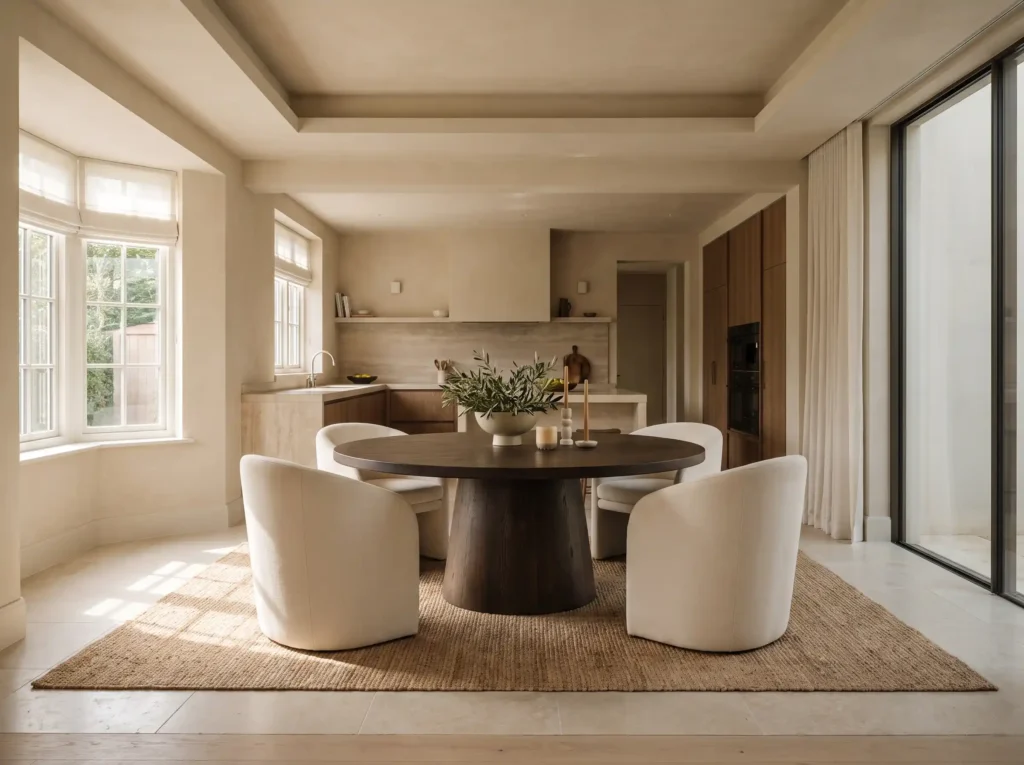
Why Circular Dining Tables Make More Sense Today
The return of the circular table comes down to human psychology and practical floor plans. Modern homes value comfortable connection, and circular geometry delivers both naturally.
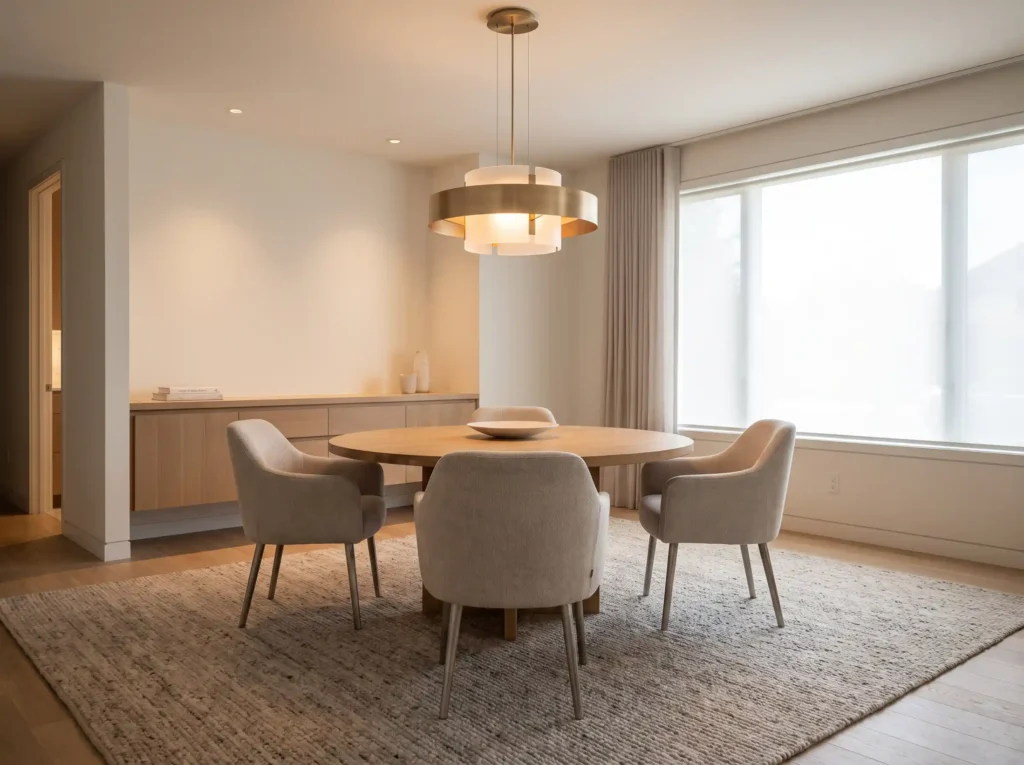
Everyone Shares One Eye Level
Rectangular tables set up an unspoken hierarchy. Someone sits at the head, someone sits at the foot, and people at opposite ends rarely speak to each other.
A round table wipes that away entirely. There is no head of the table. Every person sits on an equal plane, facing inward toward the center.
Group conversation flows naturally this way. Diners make direct eye contact across the meal rather than splitting off into isolated side chats.
Soft Edges Break Up Boxy Architecture
Walk into almost any modern home and you will see straight lines everywhere. Drywall corners, kitchen islands, cabinetry, and windows all share rigid 90-degree angles.
Adding a circular silhouette cuts straight through that visual stiffness. The curved shape softens the room instantly, making the entire living area feel grounded rather than sterile.
Smooth Walkways in Open Floor Plans
Modern homes lean heavily toward open floor plans and compact dining zones. In these spaces, room to walk around furniture is everything.
Sharp corners on rectangular tables create frustrating pinch points. People bump hips or squeeze sideways between the table corner and the kitchen island.
Round tables remove those sharp corners completely. Family members can move past the perimeter without dodging sharp edges, which makes round designs ideal for eat-in kitchens and open main floors.
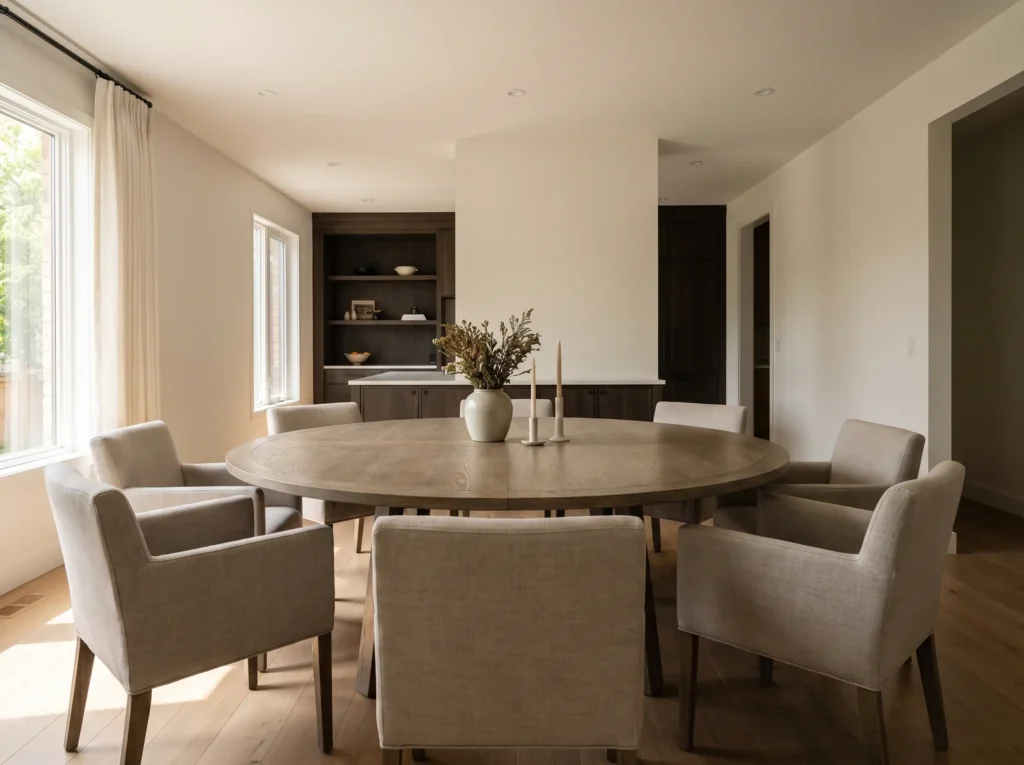
Everyday Practical Wins of Going Round
Beyond looking balanced, circular tables solve several persistent household headaches:
- Child safety: Without pointed corners at toddler eye level, bumped heads and bruised hips are far less common.
- Flexible seating: Center-pedestal designs replace corner legs. You can slide in an extra chair whenever guests show up without straddling a table post.
- Sculptural presence: Designers frequently pair round tops with fluted timber, carved travertine, or blackened oak bases that double as architectural focal points.
- Natural fit for square rooms: Elongated tables look squeezed in square rooms and bay windows. Round tables fill the center of square footprints in perfect proportion.
Clearance Rules and Styling Proportions
A round table needs the right breathing room and lighting scale to work well day to day. Measure your room dimensions before ordering.
Floor Space and Chair Pull-Out Clearances
The biggest mistake people make is measuring only the tabletop diameter. Always factor in the space needed to pull chairs out and step back comfortably.
- Standard clearance: Leave at least 36 inches between the tabletop edge and the nearest wall, credenza, or door frame.
- Corridors and busy pathways: Push that clearance to 42 to 48 inches if people frequently walk behind seated diners to reach the kitchen.
- Personal elbow room: Plan for 24 inches of perimeter space per person for standard chairs, or 30 inches if you prefer wide, upholstered armchairs.
Sizing the Rug and Hanging the Light Fixture
Scale anchors the entire room. What usually happens in real life? Homeowners buy a rug that is far too small, and the back chair legs catch on the rug border every time someone stands up.
Choose a rug that extends 24 to 30 inches past the table edge on all sides. All four chair legs should stay flat on the rug surface, even when pulled out.
For lighting, suspend a pendant or chandelier 30 to 36 inches above the tabletop. Pick a fixture with a diameter between one-half and two-thirds the table width to keep the visual balance steady.
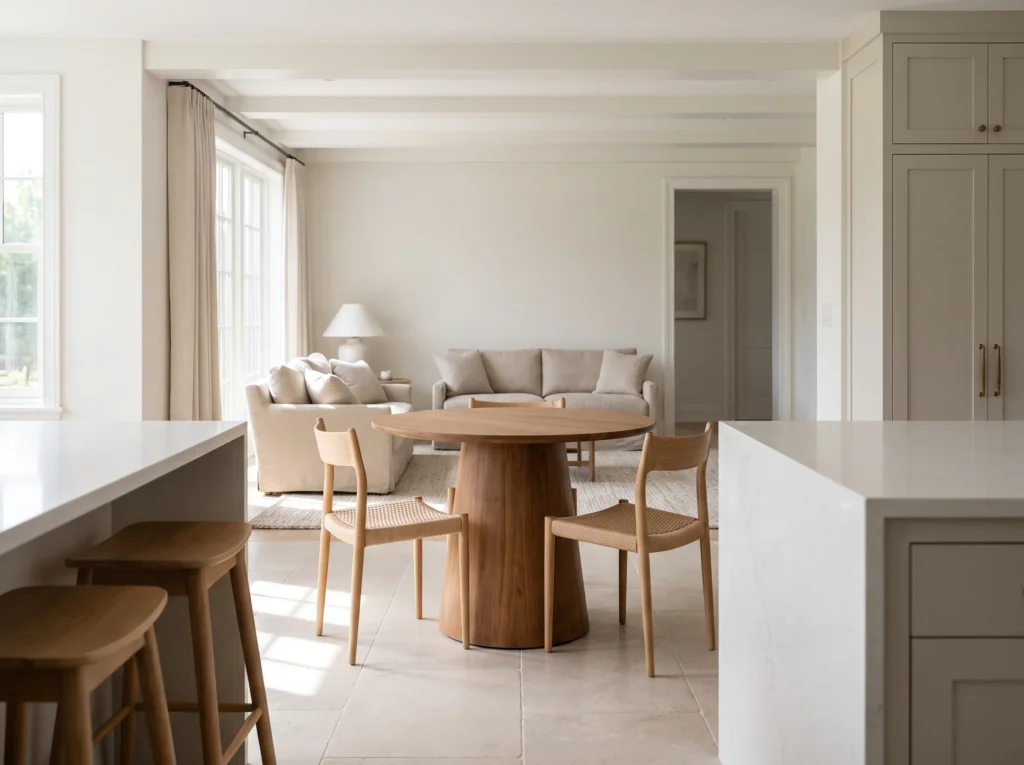
Where Round Tables Struggle and What to Expect
Round tables are versatile, but they are not universally perfect for every room layout. Consider these practical trade-offs:
- Narrow, long rooms: In a galley-style dining room, a round table eats into side walkways. An oval or rectangular table uses long footprints far better.
- No wall docking: You cannot push a round table flat against a wall to clear floor space. It requires dedicated center placement.
- The center dead zone: Tables built for eight or more people can reach 72 inches across. Reaching serving dishes across that distance is difficult without adding a Lazy Susan.
- Standard benches will not work: Straight dining benches do not pair with curved table edges. You will need individual chairs or a custom-curved banquette.
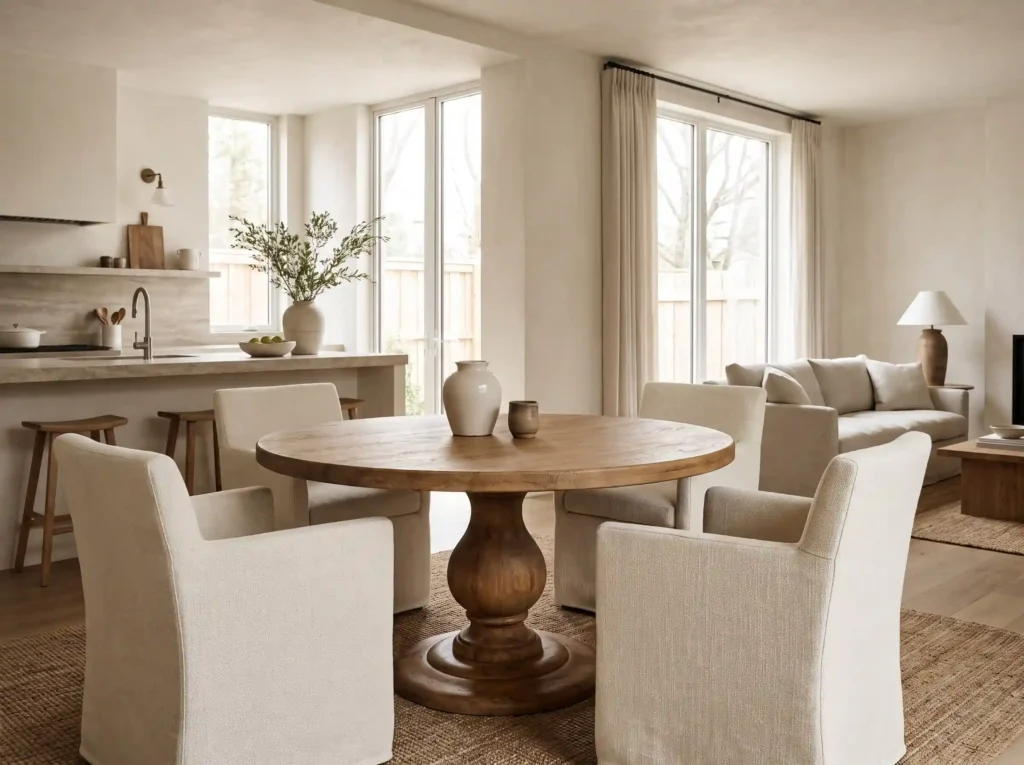
Making the Final Decision for Your Room
The popularity of round dining tables comes down to how we actually live in our homes today. We want rooms that feel welcoming, easy to walk through, and set up for real face-to-face conversation.
If your room is roughly square or sits inside an open kitchen layout, a pedestal round table is tough to beat. Give the chairs plenty of pull-out space, match the rug to the perimeter, and you will have an inviting centerpiece built for everyday living.
Sources
- Homes & Gardens — Interior Design Trends and Dining Room Layouts
- Livingetc — Modern Furniture Silhouettes and Curved Trends
- Oblist — The Resurgence of the Round Dining Table and Organic Forms
- French Tables — Spatial Flow and the Social Geometry of Dining Tables
- Modern Loft Interiors — Dining Table Base Types and Seating Capacity Guides
- Cafe Table & Chair — Circumference and Ergonomic Clearance Principles
- Cosmic Homes — Pros and Cons of Round vs. Rectangular Dining Tables
Quick Comparison
| Table Shape | Best Room Layout | Conversation Dynamic | Walkway Clearance | Wall Placement | Seating Flexibility |
|---|---|---|---|---|---|
| Round Dining Table | Square dining rooms, eat-in kitchens, bay windows | Equal plane with no head of the table; direct eye contact for all | Eliminates sharp corner pinch points in tight pathways | Requires dedicated center placement; cannot sit flush against walls | Pedestal bases allow sliding in extra chairs; incompatible with straight benches |
| Rectangular Dining Table | Long, narrow, and galley-style dining rooms | Hierarchical seating at head/foot; splits into separate side conversations | 90-degree corners can create pinch points in tight rooms | Can be pushed flush against a wall to save floor space | Easily accommodates straight bench seating; corner legs can obstruct knees |
Frequently Asked Questions
Which is better: a round or rectangular dining table?
The right choice depends on your room dimensions and how you host. A round table is best for square rooms, eat-in kitchens, and open layouts because it fosters egalitarian conversation and eliminates sharp corners in busy walkways. A rectangular table is better suited for long, narrow spaces and can be pushed against a wall to save floor space when not hosting.
How much clearance space is needed around a round dining table?
You should leave at least 36 inches between the tabletop edge and the nearest wall, credenza, or doorway to pull chairs out comfortably. If a walkway passes behind seated guests toward a high-traffic area like a kitchen, increase that clearance to 42 to 48 inches.
What size rug should go under a round dining table?
Select a rug that extends 24 to 30 inches past the table perimeter on all sides. This extra dimension ensures all four chair legs remain flat on the rug surface, preventing chair legs from catching on the border when guests slide back.
How high should a light fixture hang above a round table?
Suspend a pendant or chandelier 30 to 36 inches above the tabletop. For balanced visual scale, choose a fixture with a diameter measuring between one-half and two-thirds the diameter of your table.
Can you push a round dining table against a wall?
No, circular tables cannot dock flush against flat drywall. Pushing a round table toward a wall leaves awkward, unusable negative space behind it, making dedicated center placement essential.
What is the main drawback of a large round dining table?
When sized for eight or more guests, round tables reach 72 inches or wider, creating a large center dead zone that makes passing food across the table difficult without a Lazy Susan. Large round tables also take up considerable width, making them impractical for narrow dining rooms.
