
The contractors don’t need to show up. The tiles don’t need to come off the walls. What separates a bathroom that feels like a budget motel from one that actually lets you exhale is almost never the tile. It’s the sensory detail layered on top of it.
Most people assume a spa-like bathroom costs tens of thousands of dollars or requires gutting the room. It doesn’t. What it requires is understanding what makes a spa feel different: no visual noise, the texture of what you touch first thing in the morning, the warmth of the light at night, the scent that builds in the steam. Every one of those things is changeable without touching a pipe or filing a permit.
This guide covers what actually moves the needle — and skips everything that sounds good but doesn’t change how the room feels to be in.
Visual Calm Starts Here: Declutter First, Decorate Second
Walk into any hotel spa. The counters are bare. There’s no half-empty shampoo bottle competing for vanity space, no jumble of prescription bottles and cotton swabs crowding the sink. That visual quiet isn’t accidental — it’s the entire point. Your eye has nowhere to snag, so your nervous system stops scanning.
In most home bathrooms, counter clutter isn’t just an aesthetic issue. It creates low-grade cognitive friction every time you walk in. Fixing it costs nothing. It just requires honesty about what actually needs to live on a surface and what doesn’t.
Decant Your Toiletries and Clear Every Surface
Pull everything off your vanity tops and shower ledges. Store daily-use items inside drawers, medicine cabinets, or behind vanity doors. What you keep out in the open should be intentional — not whatever happened to land there last Tuesday.
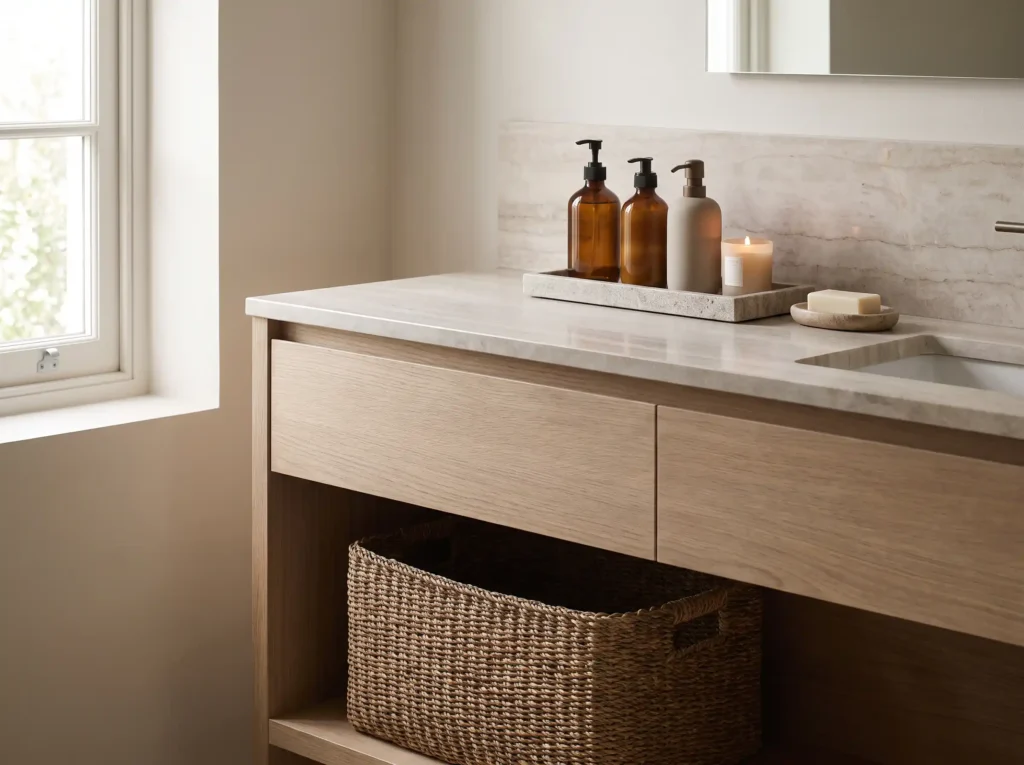
For the things that genuinely need to stay visible, swap mismatched plastic bottles for matching amber glass or ceramic pump dispensers. The product inside doesn’t change. The visual cohesion does. Here’s what works particularly well:
- Apothecary jars: Cotton rounds, bath salts, and swabs look considered rather than abandoned when they sit in clean glass jars with simple lines. The same exact items. Completely different feeling.
- Woven storage bins: Seagrass or fabric-lined baskets inside open shelving handle extra paper goods and grooming appliances without making the shelves look chaotic.
- Vanity tray groupings: A marble or wood tray does something specific — it signals that the objects on it are there on purpose. A candle, a soap dish, one or two well-chosen items. The tray creates a boundary, and everything outside it reads as noise.
Replace Cold Surfaces With Bamboo, Teak, and Woven Textures
Builder-grade bathrooms default to chrome, cold porcelain, and flat drywall. Nothing about that combination says “come in and slow down.” Layering in one or two warm, tactile materials shifts the room without touching a wall.
A bamboo or teak bathtub caddy is the most immediate version of this. Rest it across the tub with a book, a candle, or a small beverage during a soak. The material alone — natural, warm, slightly imperfect — changes what the room is asking you to do when you walk in. That matters more than most people realize.
Scent, Texture, and Touch: The Sensory Upgrades That Change How the Room Feels
Spas are multi-sensory environments by design. The scent reaches you before you’ve noticed the lighting. The towel you reach for is heavier than expected. The mat under your feet doesn’t slide. None of that happens by accident, and none of it requires a contractor.
Upgrade Your Towels to Turkish or Egyptian Cotton
Faded, thin towels are the fastest way to undermine a bathroom that otherwise looks good. The texture you reach for right after a shower has an outsized effect on whether the whole experience felt like a spa or not. Turkish and Egyptian cotton towels — thick, absorbent, and in a neutral palette — are the single best tactile upgrade you can make.
Stick to a tight color story: crisp white, warm sand, or muted sage. Mixing neutrals works. Mixing neutrals with a patterned set from five years ago does not.
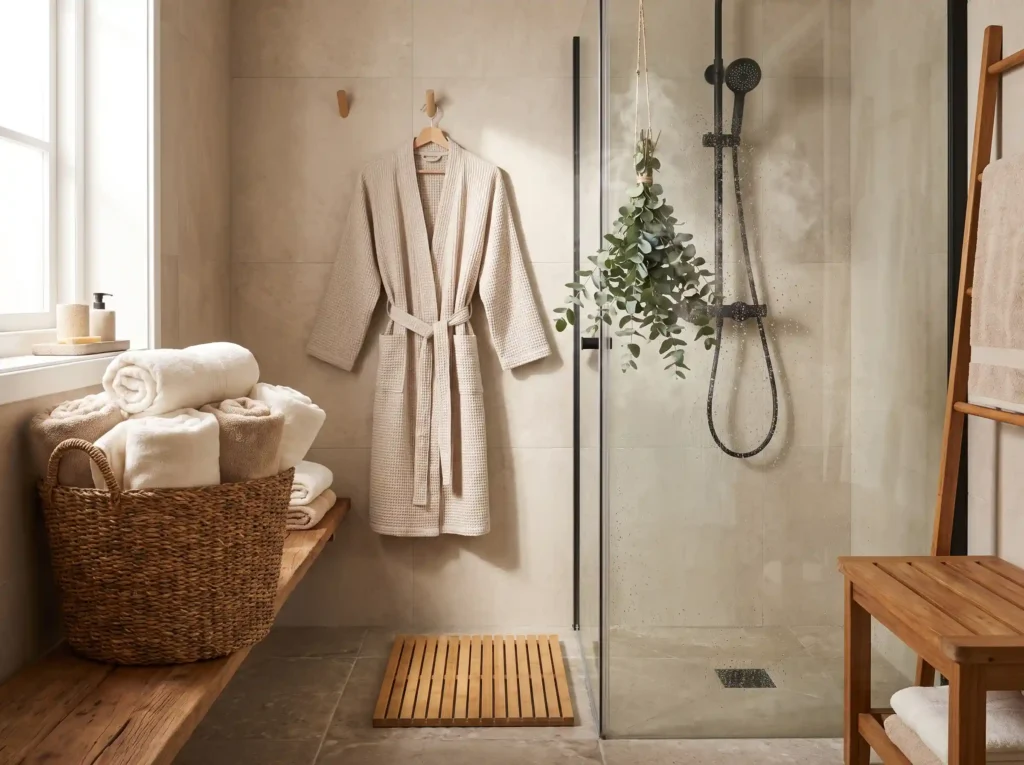
- Roll instead of fold: Tightly rolled towels displayed in a basket or on a wooden ladder shelf read as intentional in a way that stacked folded towels don’t. It’s a salon approach, and it works.
- Dense bath rug or bamboo slat mat: Replace any thin synthetic mat with something that feels substantial underfoot. A bamboo slatted mat dries quickly and holds up well to daily moisture — important in a room where mildew is always a background risk.
- Waffle-weave robe on a wall peg: One robe, hung on a dedicated hook near the shower, completes the post-shower experience in a way that surprises people who haven’t tried it.
Eucalyptus, Reed Diffusers, and Aromatherapy That Earns Its Place
Scent works on your nervous system faster than almost anything else you can change in the room. The eucalyptus shower bundle is the most popular version of bathroom aromatherapy for a reason. Bundle fresh eucalyptus branches with twine and hang them behind your showerhead, positioning them outside the direct spray. The steam from a hot shower releases eucalyptol — the active compound in eucalyptus — into the air, creating a natural steam-room effect that is genuinely useful for sinus clearing and stress relief.
For continuous background scent, a reed diffuser with lavender, cedarwood, or bergamot on a high shelf works well. A clean-burning soy candle lit before an evening bath does the same job with more atmosphere.
A Real Warning for Pet Owners: Eucalyptus Is Toxic to Cats and Dogs
This is worth treating seriously, not just filing away as a footnote. The ASPCA classifies eucalyptus as toxic to both dogs and cats. Concentrated eucalyptol vapors from steam sessions can cause drooling, vomiting, weakness, and respiratory distress — not as an unlikely worst case, but as a documented exposure risk.
If you share your home with animals, keep the bathroom door closed during and immediately after any eucalyptus steam session. Or skip eucalyptus entirely. A certified pet-safe reed diffuser blend covers the same therapeutic ground without the risk.
Hardware Swaps That Look Like a Renovation and Cost a Fraction of One
You don’t need to change in-wall plumbing to dramatically improve how your shower feels. Two specific swaps — a new showerhead and coordinated cabinet hardware — do more visible work than almost any other non-structural change you can make.
How to Replace Your Showerhead in 30 Minutes Without a Plumber
A wide rainfall showerhead, or a multi-setting handheld wand, changes the physical experience of your shower in a way no amount of decoration replicates. The project takes basic household tools and under thirty minutes:
- Protect the shower arm: Wrap a soft cloth around the existing shower arm before touching it with a wrench. Metal tool jaws scratch the finish without it.
- Remove the old showerhead: Hold the wall arm steady with one wrench and turn the old showerhead counterclockwise with a second. Using two wrenches prevents you from twisting the pipe inside the wall. That is a significantly bigger problem than a scratched finish.
- Clean the pipe threads: Scrub away old thread compound, rust flakes, and disintegrated tape from the male pipe threads. An old toothbrush works well here.
- Wrap with PTFE plumber’s tape: Wrap PTFE plumber’s tape clockwise around the threads two to three times. Clockwise matters. It keeps the tape flat and seated as you thread on the new fixture, rather than pulling it apart.
- Thread and check for leaks: Screw the new showerhead on by hand until snug, then a gentle quarter-turn with the wrench. Run the water and check the joint carefully. A bead of water at the connection means you need another half-turn or an extra layer of PTFE tape.
One thing most people overlook: if the old showerhead had mineral buildup, the threads likely do too. Clean them well before seating the new fixture. A bad thread connection is the most common reason for a slow drip that shows up three days after installation — not a faulty showerhead.
Coordinating Hardware Finishes: How One Cohesive Choice Unifies the Room
Standard builder-grade cabinet knobs, towel rings, and toilet paper holders share one quality: they look like they came with the building. Nobody actually chose them. Swapping them for a single coordinating finish — matte black, brushed brass, or satin nickel — does something specific. The room stops looking like an assembly of parts and starts looking like a decision was made.
You don’t need to replace every piece at once. Start with the towel bar and toilet paper holder. Those are the most visible pieces in the room. Work backward from there.
Fix the Lighting: Kelvin, CRI, and Why Dimmers Change Everything
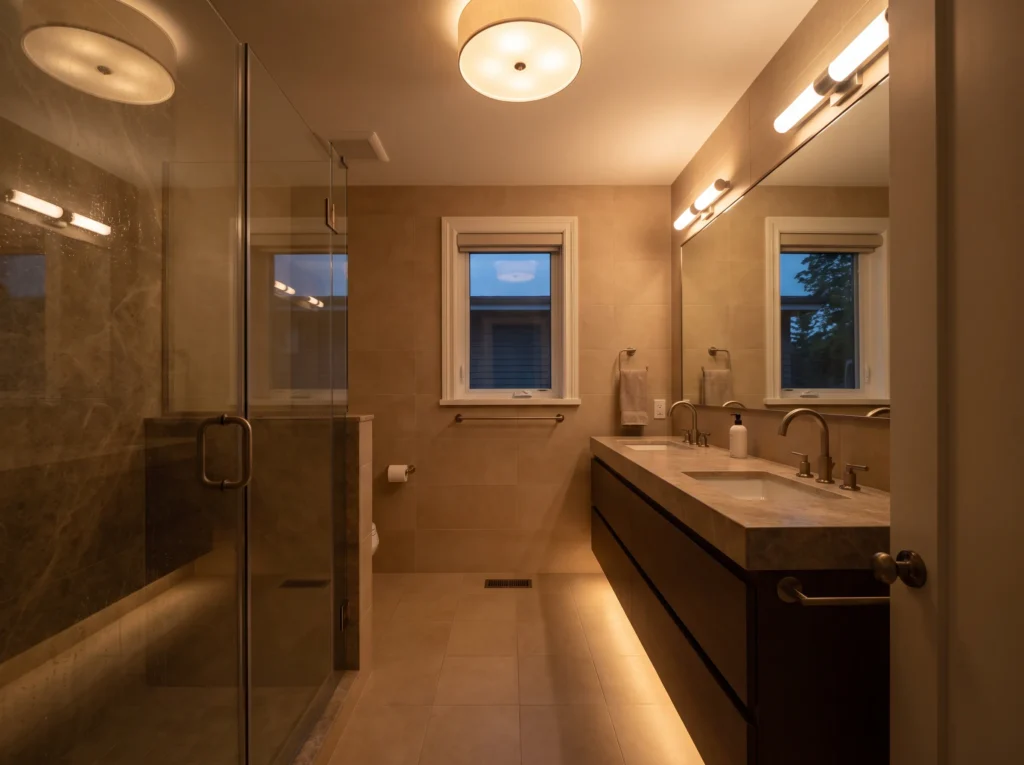
The overhead bathroom fixture in most homes is a liability. Cool-white, high-intensity light is designed for visibility — fine at 7 a.m., actively counterproductive at 10 p.m. when your body is supposed to be winding down. Harsh overhead light keeps you in alert mode. That’s not a soft preference — it’s basic physiology, and it’s why professional spas never rely on a single ceiling fixture.
What Kelvin Temperature and CRI Actually Mean for Your Bathroom
Two numbers matter when you’re buying bathroom light bulbs: Kelvin temperature and CRI.
- Ambient and relaxation lighting (2,700K – 3,000K): Warm-white bulbs in this range produce the golden, low-intensity light associated with winding down. Use them in ceiling fixtures and any accent lights you add for evening use. Below 2,700K looks orange and unflattering. Above 3,000K gets noticeably cooler and more clinical.
- Vanity and mirror lighting (3,000K – 3,500K): Your grooming light should be neutral. Too warm and you can’t accurately judge makeup, shaving quality, or skin tone. This range gives you accuracy without clinical harshness.
- Color Rendering Index (90+ CRI): CRI measures how accurately a light source renders color compared to natural daylight. A 90+ CRI LED means your skin tone, the tile, and the towels appear true to life. Below 80 CRI, natural materials look flat and washed out. That undermines exactly the warm, textured aesthetic you’re building.
Dimmer Switches and Low-Level Accent Lights: Creating Two Modes in One Bathroom
The goal is a bathroom that runs in two distinct modes: bright and functional in the morning, dim and calm in the evening. A dimmer switch on the existing overhead circuit is the most direct way to get there. Dimmers compatible with LED bulbs are widely available and relatively simple to install. If electrical work is outside your comfort zone, a licensed electrician is worth the one hour of labor.
If hardwiring isn’t an option, there’s an alternative that works just as well. Battery-operated LED puck lights mounted under the vanity, or rechargeable warm-glow lamps on a deep window ledge, create the same layered effect without any wiring at all.
Bathroom Plants That Actually Survive: Matching the Plant to the Real Conditions
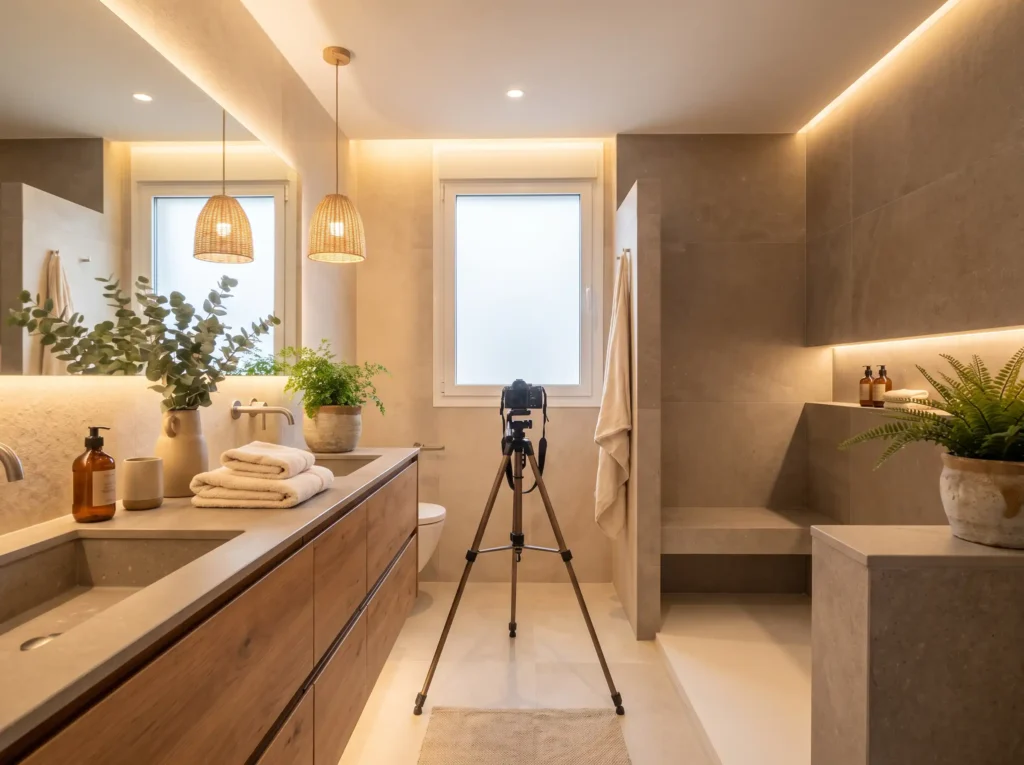
Live plants do real work in a bathroom. They soften hard tile lines, add visual depth that no accessory exactly replicates, and absorb excess moisture from the air. The key is matching the plant to the actual conditions — not the conditions you wish the bathroom had.
Most bathrooms have high humidity, inconsistent temperatures, and limited natural light. These four plants are genuinely suited to that environment:
- Snake Plant (Sansevieria): Upright and architectural, handles low light and humidity swings better than almost anything else. Ideal for a vanity corner where nothing else survives.
- ZZ Plant (Zamioculcas zamiifolia): Glossy, waxy leaves that hold up well in low light — including windowless bathrooms. Slow-growing and nearly indestructible.
- Pothos (Epipremnum aureum): Thrives on moisture and drapes well from a macramé planter or a high shelf. One of the fastest-growing options if you want visible results quickly.
- Bird’s Nest Fern (Asplenium nidus): A tropical plant that genuinely loves the steamy aftermath of a hot shower. Lush, soft fronds that look intentional rather than incidental.
Here’s where most people go wrong with bathroom plants: the steam fools them. High ambient humidity slows soil evaporation dramatically. People see a steamy room and assume the plant is fine. Then they add water anyway. Root rot from overwatering is the most common reason bathroom plants fail — not the light, not the humidity. Check that the top two inches of soil are dry before adding water. Always.
Mildew, Moisture, and Lease Protection: Maintenance You Cannot Skip
Introducing natural materials into a high-humidity room is a commitment. Teak, bamboo, cotton, and woven textures absorb bathroom moisture quickly. If airflow isn’t managed, mildew follows within weeks.
Run your exhaust fan for at least 15 to 20 minutes after every shower — not just during it. Most exhaust fans are underused because people turn them off the moment they leave. The fan’s job isn’t to clear steam while you’re in the room. It’s to pull residual moisture from surfaces after you’ve left. Hang bath mats over the edge of the tub between uses, and wipe down wooden caddies weekly.
If you’re renting, follow a specific protocol for every hardware swap. Before removing any original piece — showerhead, cabinet knobs, switch plates — put it in a labeled ziplock bag with its mounting screws. Store the bag in a box in a closet. When your lease ends, you can restore the bathroom in under an hour and walk away with your full security deposit. Landlords have seen enough amateur-hour upgrades that leaving a room exactly as you found it is often the best possible outcome on a move-out inspection.
The Part Nobody Tells You
No single thing on this list will transform your bathroom. That’s what most guides skip.
You can install the best rainfall showerhead available. If the lighting is still harsh and the counter is still cluttered, the room will still feel like a bathroom. The transformation is cumulative. Each layer — cleared surfaces, warm lighting, a quality towel, a plant in the corner — adds a signal. Your nervous system reads that signal as: this is a place for slowing down. When enough of those signals stack, the room changes.
Not from one dramatic purchase. From the accumulation of small, considered ones.
Pick two or three things from this guide and do them this weekend. Then stop. Notice how the room feels different before adding anything else. That sequencing — change, notice, adjust — is how good environments actually get built.
Sources
- Bob Vila: How to Create a Spa-Like Bathroom at Home
- This Old House: How to Replace a Showerhead
- Martha Stewart: Spa-Like Bathroom Design Ideas
- ASPCA Animal Poison Control: Eucalyptus Toxicity
- Architectural Digest: Bathroom Lighting and Ambiance Guide
- The Spruce: The Best Houseplants for Bathrooms
Quick Comparison
| Plant | Light Tolerance | Ideal Placement | Moisture & Humidity Suitability |
|---|---|---|---|
| Snake Plant | Handles low light and humidity swings | Vanity corner where little else survives | Tolerates humidity swings; requires top 2 inches of soil to dry before watering |
| ZZ Plant | Low light, including windowless bathrooms | Vanity, high shelf, or windowless space | Indestructible waxy leaves; slow soil evaporation requires minimal watering |
| Pothos | Adaptable ambient light | Macramé planter or high shelf | Thrives on steam and ambient moisture; fast-growing trailing habit |
| Bird’s Nest Fern | Indirect tropical light | Dedicated spot near the shower | Genuinely thrives in the steamy aftermath of hot showers |
Frequently Asked Questions
Which cotton is best for spa-quality bathroom towels?
Turkish and Egyptian cotton are the premier options because their dense, long fibers provide superior absorbency and weight. Selecting a cohesive neutral palette like crisp white, warm sand, or muted sage—and rolling rather than stacking towels—creates a deliberate salon look.
Is eucalyptus safe to use in a bathroom with pets?
No, eucalyptus is toxic to both cats and dogs according to the ASPCA. Concentrated eucalyptol vapors released by hot steam can trigger drooling, vomiting, weakness, and respiratory distress. If you share a home with animals, keep the door closed during steam sessions or choose a certified pet-safe reed diffuser instead.
What Kelvin color temperature is ideal for bathroom lighting?
Ambient and evening lighting should use warm-white bulbs between 2,700K and 3,000K to help your nervous system wind down. For vanity and mirror tasks like shaving or makeup, choose neutral bulbs in the 3,000K to 3,500K range with a 90+ CRI rating to ensure colors and skin tones render accurately.
Can you replace a showerhead without hiring a plumber?
Yes, swapping a showerhead takes under thirty minutes using basic household tools. Use two wrenches—one holding the shower arm steady and one turning the fixture—to avoid twisting internal wall pipes, and wrap the threads clockwise with PTFE plumber’s tape before threading on the new unit.
Which houseplants can survive in a windowless bathroom?
The ZZ plant is the most reliable option for windowless bathrooms due to its ability to thrive in extremely low light. Because high humidity slows soil evaporation, check that the top two inches of soil are dry before watering any bathroom plant to prevent fatal root rot.
