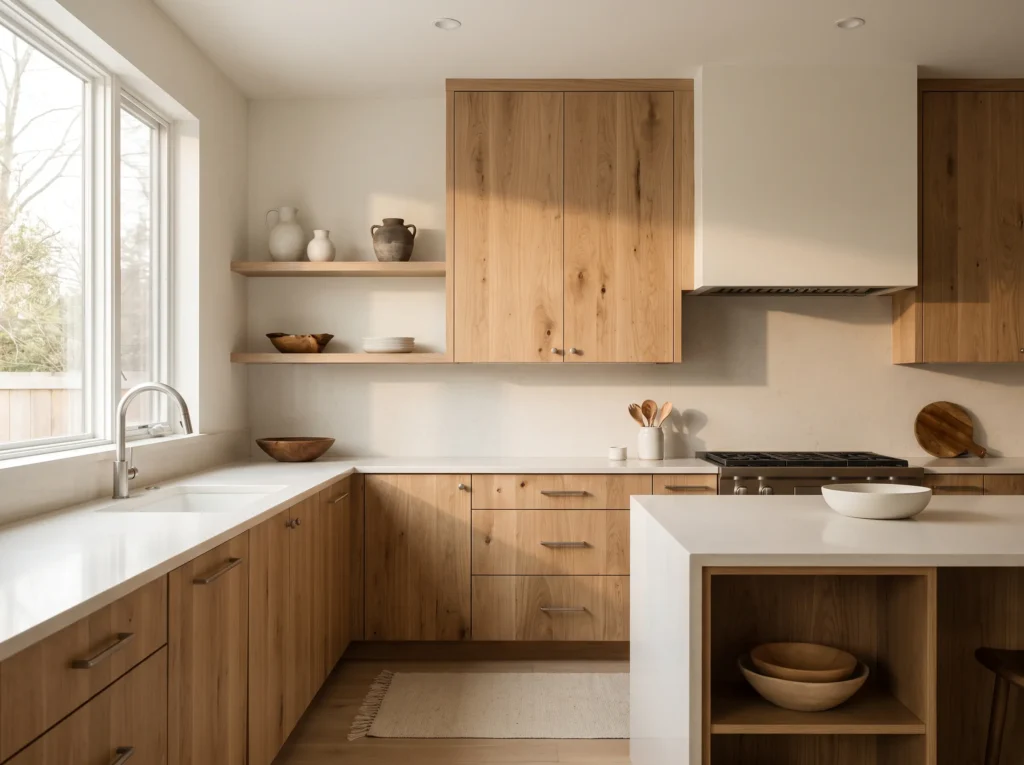
The white kitchen dominated residential interiors for about fifteen years. It photographed well, sold homes well, and felt like a safe bet. Then the chips appeared near the toe kicks. The yellowing crept in around the range. Slowly, those pristine surfaces started feeling less like a design choice and more like a maintenance burden. Natural wood cabinets are what homeowners are reaching for instead — not as a nostalgic throwback, but as a correction.
Wood has outlasted every painted finish cycle in the history of residential design. It doesn’t just hold up. It improves.
What’s Driving Homeowners Back to Wood
The Design Philosophy Behind the Shift
The National Kitchen & Bath Association (NKBA) has tracked the return of wood grain cabinetry as part of the biophilic design movement. At its core, biophilic design is simple: people function better in spaces that include natural materials. Wood fits that principle in ways painted surfaces don’t.
The grain moves with the light. The texture invites touch. The color shifts subtly between morning daylight and evening pendant lighting. That organic variation is harder to photograph than a pristine white kitchen, but it’s what makes a space feel genuinely lived-in rather than staged.
A kitchen can look perfect in listing photos and feel wrong to live in. Wood tends to close that gap.
What the Numbers Confirm
The 2026 U.S. Houzz Kitchen Trends Study confirmed what designers had been noting anecdotally. Wood has overtaken white as the most popular cabinet finish — 29% of renovating homeowners chose wood compared to 28% who chose white. Among those selecting wood, the preference leaned toward balance over drama:
- Medium-toned wood: Chosen by 15% of renovating homeowners.
- Light wood: Chosen by 11%, often for Scandinavian-leaning interiors.
- Dark wood: Chosen by 3%, for moody, high-contrast aesthetics.
One percentage point separates wood from white. That’s not a landslide — it’s a turning point. And the direction of travel matters more than the margin.
Why Wood Ages Better Than Paint
The Organic Character Paint Can’t Replicate
Every cut of timber is different. Cathedral grain patterns, fine growth rings, subtle variation between the heartwood and outer sapwood — these aren’t inconsistencies in the material. They’re what make the cabinetry feel made rather than manufactured. Set against the hard, reflective surfaces typical in kitchens — polished stone, porcelain tile, stainless steel appliances — that organic variation does real visual work. It softens the room without making it feel soft.
Painted cabinet doors start out looking their best. Daily use chips them near the handles. Micro-scratches accumulate across the face. Oily smears show clearly on a flat matte or semi-gloss surface. The wear reads as deterioration.
On quality wood, that same daily contact builds something else. The finish deepens slightly near high-touch areas. Edges smooth from repeated handling. The wear reads as patina — and patina reads as character.
What Patina Looks Like in a Real Kitchen
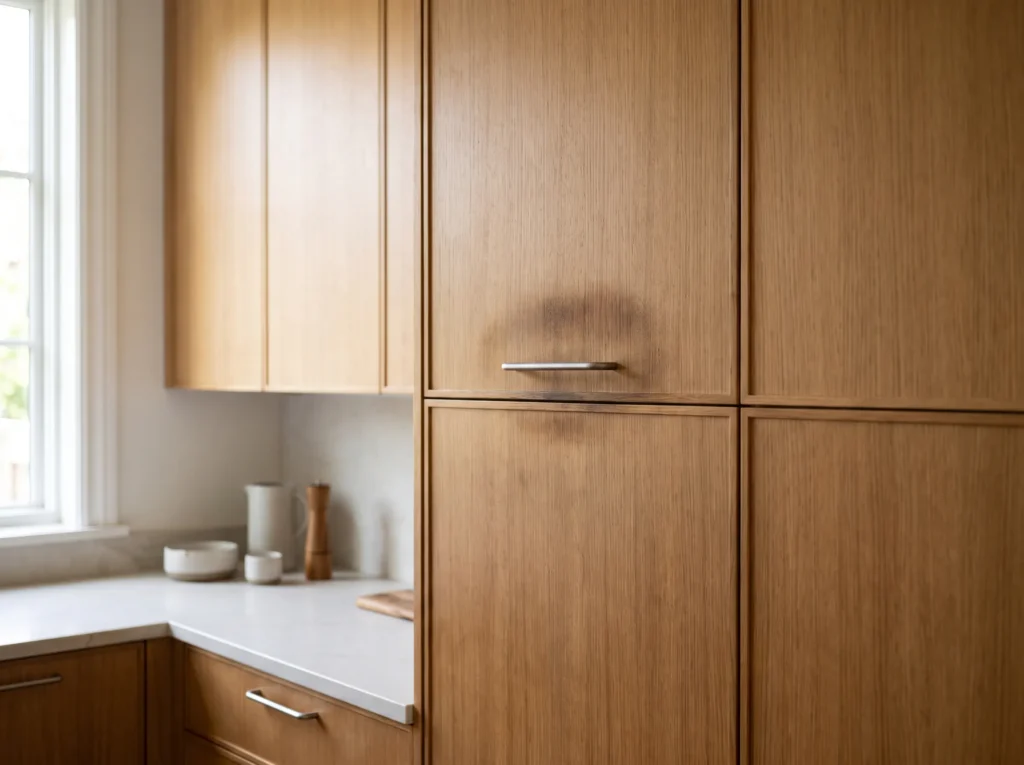
Most people picture patina as something dramatic — aged barn wood, weathered leather, obviously distressed surfaces. On kitchen cabinetry, it’s more subtle than that.
The areas near the pull or knob darken slightly and develop a glassy smoothness from repeated contact. The overall finish gains a depth it didn’t have when the cabinets were new. Nothing is obviously worn. It just looks more settled.
This is what most people overlook when comparing wood to painted finishes: painted surfaces have no recovery mechanism. A chip stays a chip. Wood — especially with a quality oil or hardwax finish — can be spot-repaired. And even without repair, the daily wear usually improves the look rather than undermining it.
Modern Wood Cabinets Look Nothing Like the 1990s
The mental image most people carry of wood cabinetry belongs to a specific era. Heavy golden oak. Thick high-gloss lacquer. Raised-panel cathedral doors with elaborate routed moulding. Contemporary wood cabinetry shares almost nothing with that look except the material itself.
Wood Species That Define the Modern Kitchen
White oak is the dominant choice in contemporary renovations, and the reason comes down to undertone. Unlike the golden oak of the 1990s, white oak doesn’t cast yellow or orange. Its natural tone ranges from light gray-beige to warm taupe — neutral enough to suit modern and transitional layouts without looking forced. Rift-cut and quarter-sawn varieties show clean, linear grain rather than the busier cathedral pattern, reinforcing the contemporary read.
Walnut reads differently. Deep chocolate tones with a slight reddish warmth, a natural density that feels quietly luxurious. It pairs well with mid-century modern references and tends to anchor a room rather than blend into it. If white oak is the versatile option, walnut is the deliberate one.
Hard maple and cherry offer something quieter: tight grain structures and smooth surfaces that take finish evenly. They’re less visually dramatic than oak or walnut. That’s actually their advantage — when the countertop or backsplash is meant to carry the room, the cabinetry shouldn’t compete.
How Door Profile and Finish Change the Entire Equation
The door profile is the single biggest factor in whether wood reads as timeless or dated.
Heavy crown moulding and arched cathedral panels are what put the “1990s” in 1990s kitchens. Replace those with flat-panel slab doors or slim-rail micro-Shaker profiles, and the same wood material becomes a contemporary choice. The organic character stays. The dated geometry goes.
Finish follows the same logic. High-gloss lacquer gave 1990s oak its plasticky, heavy feeling. Modern wood finishes lean matte or satin. Oil finishes, hardwax oils, and low-sheen clear coats seal the wood without changing how it looks or feels. The wood is fully protected. It just doesn’t announce it.
Pairing Wood Cabinets Without Overwhelming the Room
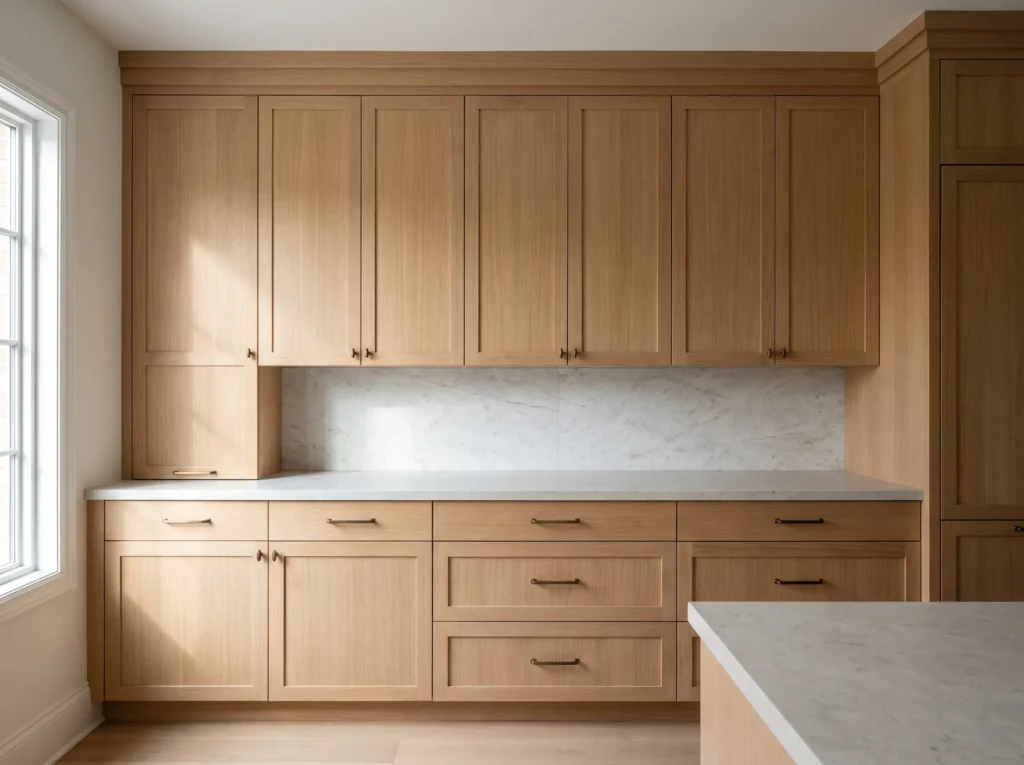
Wood introduces significant visual texture. That’s a strength — but it means the materials surrounding it need to work with the grain rather than compete with it.
Countertop Choices That Work With Wood
The countertop pairing is where most wood kitchens succeed or fail.
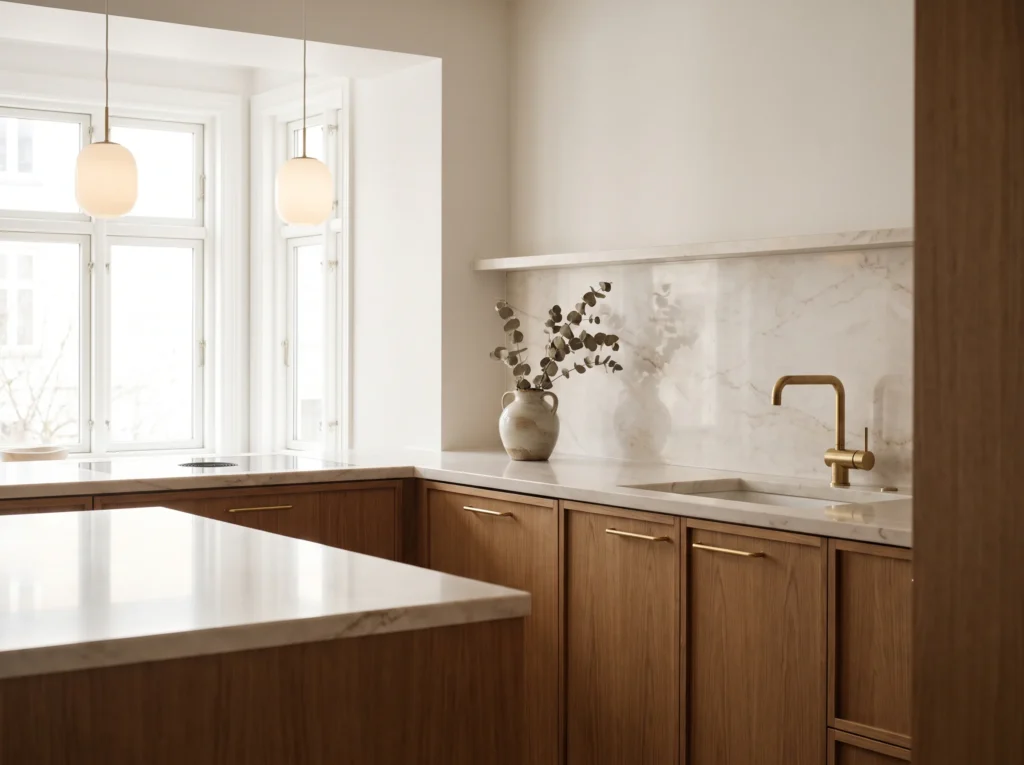
Warm white quartz and marble with soft, low-contrast veining brighten the room and prevent the cabinetry from reading too heavy. The contrast between a lighter surface and the warmth of the grain keeps the kitchen from closing in visually.
Earthy quartzite — soft taupe, muted beige, or something like Taj Mahal quartzite — harmonizes with the undertones of medium-toned wood. It’s a quieter, more organic pairing that works well when the overall intent is calm rather than dramatic.
Soapstone and honed charcoal granite create sharp contrast against pale wood. The dark matte surface against light grain reads as artisanal and grounded — better suited to kitchens where the cabinetry and stone are meant to work as the room’s primary focal point.
The mistake most people make: choosing a countertop in the same value range as the wood. When the stone and the cabinet face are similar in both warmth and lightness, they blend and the room reads as muddy. Some contrast — in lightness, in undertone, or both — is what keeps the palette coherent.
Hardware That Reinforces or Contrasts
Hardware is often treated as an afterthought. It shouldn’t be — the finish you choose either reinforces the warmth of the wood or creates deliberate contrast against it.
Brushed brass, unlacquered brass, and champagne bronze echo the warm undertones of oak and walnut without looking matchy. They add quiet richness without competing with the grain. Matte black hardware creates a graphic, grounding contrast — especially effective on pale wood. Oil-rubbed bronze sits between the two: warmer than matte black, less reflective than polished brass, useful when you want cohesion over contrast.
One thing to avoid: high-gloss polished hardware alongside a matte wood finish. The reflectivity mismatch tends to make the hardware look cheap even when it isn’t.
The Two-Tone Kitchen as a Design Choice, Not a Compromise
For homeowners hesitant to commit to an all-wood kitchen, the two-tone layout is a strong entry point. Wood on the lower cabinets and island grounds the layout at eye level. White or muted sage-green upper cabinets keep sightlines light and stop the room from feeling enclosed.
The two-tone approach has moved past its hesitant reputation. In well-executed kitchen design, it’s a deliberate choice — the contrast between wood base and lighter uppers is part of the design language, not a symptom of indecision. Explore it as an option in its own right, not just as a stepping stone to a fully committed wood kitchen.
What Wood Cabinet Maintenance Actually Looks Like
Wood is organic material. It responds to moisture and temperature in ways paint doesn’t. Understanding that upfront is what separates homeowners who are happy with their wood cabinets from those who regret the choice.
Humidity Is the Variable Most People Underestimate
Wood fibers expand in humid air and contract when the air dries. In an unconditioned or poorly ventilated kitchen, that movement creates hairline cracks at joinery seams and gradual warping in door panels. The solution is straightforward: maintain indoor relative humidity between 35% and 55% year-round.
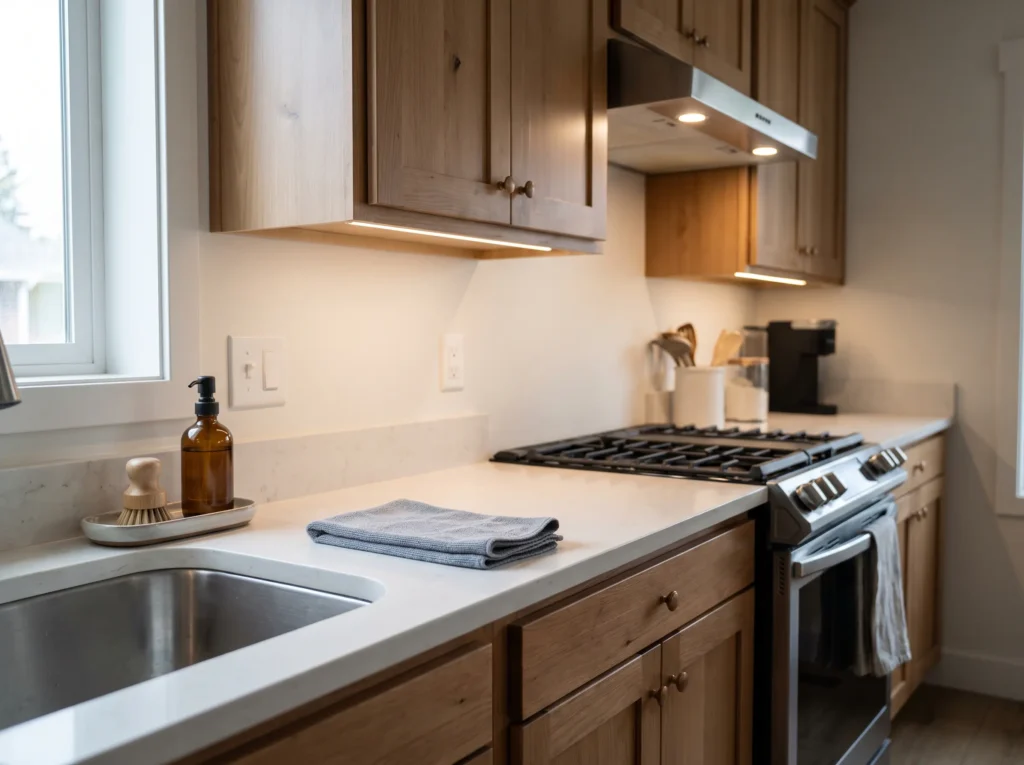
In practice, this means running the range hood consistently when boiling or steaming — not just when smoke triggers it. It means a dehumidifier during wet summer months in humid climates, and added humidification during dry winter heating seasons.
Most homeowners who end up with warped cabinet doors weren’t doing anything dramatically wrong. They just weren’t paying attention to seasonal humidity swings. It’s one of those maintenance realities that’s easy to prevent and difficult to reverse — exactly the kind of thing worth knowing before installation, not after.
Daily Cleaning Without Damaging the Finish
Standing water is the primary day-to-day hazard. Steam-producing appliances — kettles, pressure cookers, rice cookers — should be positioned away from cabinet door faces. Spills near the sink and dishwasher need to be wiped up immediately. Not eventually. Immediately.
For routine cleaning, skip the all-purpose sprays. Ammonia-based cleaners, harsh detergents, and abrasive pads strip protective topcoats faster than daily use does. A soft microfiber cloth with warm water and a small amount of mild dish soap handles almost everything. Follow with a dry cloth to remove surface moisture. That’s genuinely all the routine maintenance most wood kitchens need.
What most people don’t realize: wood cabinets are easier to spot-repair than painted ones. A scratch in a painted finish means sanding, priming, and color-matching — and the repair usually shows. A scratch in an oiled or hardwax-finished wood surface can often be addressed with a matching touch-up oil. The repair disappears into the grain.
The Long View on Wood Cabinets
The question worth asking isn’t “Will I get tired of wood?” It’s whether the material can grow with the kitchen rather than just age in it.
Painted finishes have one trajectory: they start at their best and decline from there. Wood works differently. The patina that builds over years of family meals and early mornings and daily use becomes specific to that kitchen, that house, those people. No factory finish replicates that.
That’s not a trend. That’s the difference between a kitchen that documents your life and one that merely contains it.
Sources
- Houzz: 2026 U.S. Houzz Kitchen Trends Study
- National Kitchen & Bath Association (NKBA): Kitchen & Bath Design Trends
Quick Comparison
| Wood Species | Natural Undertones | Grain Profile | Best Design Aesthetic |
|---|---|---|---|
| White Oak | Light gray-beige to warm taupe | Clean, linear grain (rift-cut or quarter-sawn) | Modern, Scandinavian, and transitional layouts |
| Walnut | Deep chocolate with subtle reddish warmth | Dense, quietly luxurious grain | Mid-century modern and grounding focal points |
| Hard Maple & Cherry | Smooth, even neutral surfaces | Tight grain structure with uniform finish uptake | Quiet backdrops when stone or backsplash carries the room |
Frequently Asked Questions
Why are wood kitchen cabinets overtaking painted white cabinets?
Homeowners are pivoting away from white cabinetry primarily due to maintenance fatigue, such as chipping near toe kicks and heat-induced yellowing near ranges. Natural wood aligns with biophilic design principles, introducing organic grain texture and shifting light that feel comfortable to live in rather than merely staged for listing photos.
How do modern wood cabinets differ from 1990s oak styles?
Modern wood cabinetry eliminates the thick, high-gloss yellow lacquer and ornate cathedral raised-panel doors that characterized the 1990s. Contemporary designs prioritize low-sheen satin or matte finishes, flat slab or micro-Shaker door profiles, and species like rift-cut white oak or rich walnut with clean, linear grain lines.
Are wood cabinets easier to repair and maintain than painted cabinets?
Yes. When painted cabinet doors chip or scratch, they require extensive sanding, priming, and precision color matching that rarely blends invisibly. By contrast, natural wood treated with oil or hardwax finishes can be spot-repaired with touch-up oil, and natural handling creates a protective patina that enriches the wood over time.
What indoor humidity level is recommended for wood cabinetry?
Indoor relative humidity should be maintained between 35% and 55% year-round to prevent wood panels from expanding, contracting, cracking, or warping. Using range hoods during cooking, running dehumidifiers in damp summers, and adding indoor humidification during dry heating seasons protects the cabinet joinery.
What is the safest way to clean natural wood cabinets every day?
Clean wood cabinet faces using a soft microfiber cloth dampened with warm water and a small drop of mild dish soap, followed immediately by drying with a clean towel. Harsh detergents, ammonia sprays, abrasive scrub pads, and steam from countertop appliances should be avoided because they strip the protective topcoat.
Which countertop materials pair best with natural wood cabinets?
Warm white quartz and softly veined marble brighten the kitchen and balance the weight of the wood grain, while earthy quartzites like Taj Mahal harmonize naturally with medium-toned cabinetry. For striking artisanal contrast, dark soapstone or honed charcoal granite creates a dramatic focal point against light wood tones.
